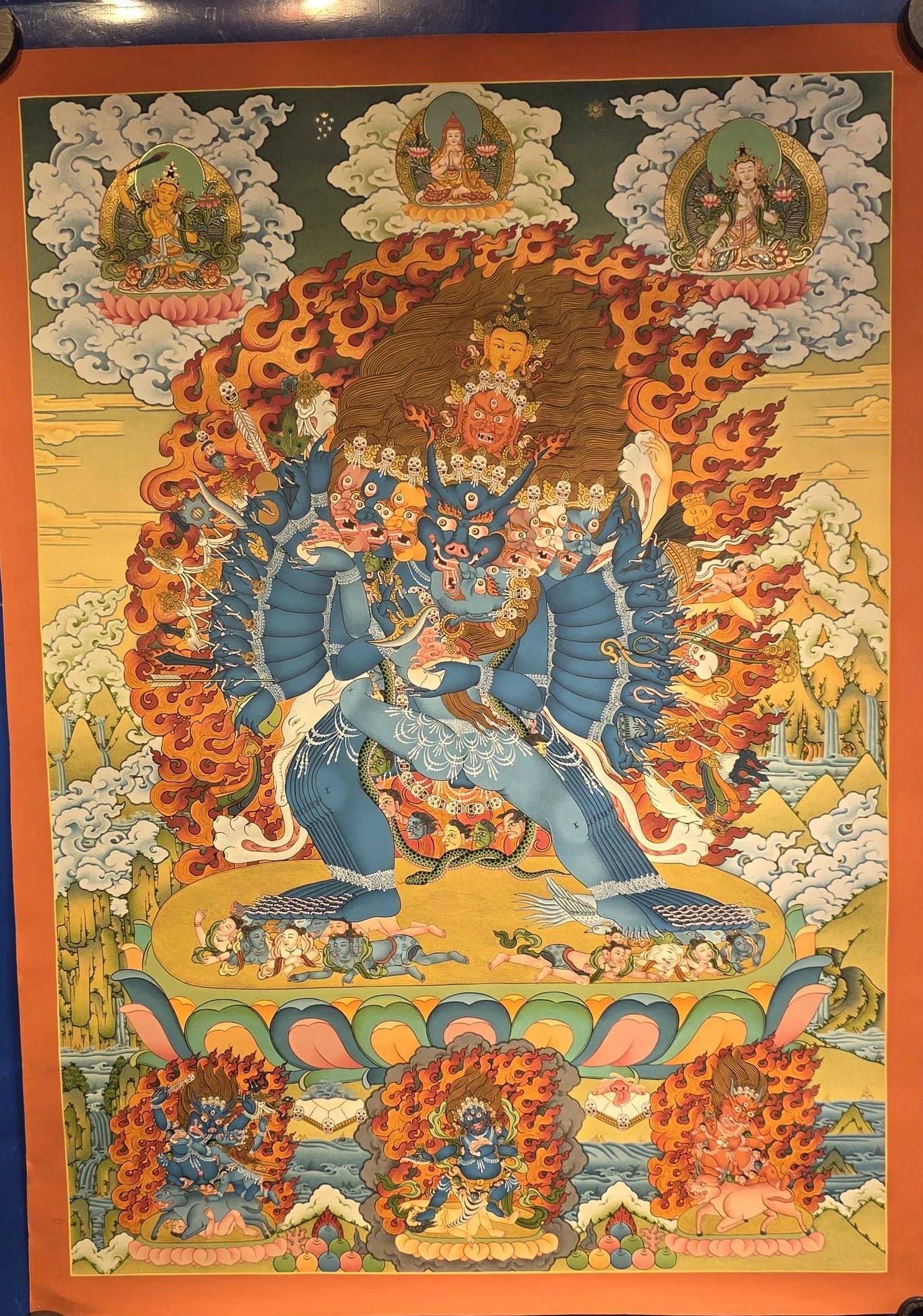
Original Painting
Yamantaka Vajrabhairava
$840- Deity
- Yamantaka
- Dimensions
- 64 x 90 inches
- Medium
- Mineral pigments, 24 karat gold on a Cotton canvas
This Yamantaka Vajrabhairava thangka painting depicts the wrathful destroyer of death in his complete nine-headed, thirty-four-armed form, rendered in mineral pigments and gold on cotton canvas. Yamantaka (Skt: Yamāntaka, Tib: Shinjeshe) is the wrathful emanation of Manjushri, the Bodhisattva of Wisdom. His name translates as "terminator of death." In this composition, the principal buffalo head bears three glaring eyes beneath a crown of skulls, with eight additional heads rising in tiers above it. The topmost face is that of Manjushri himself, serene and golden. A reminder that this ferocity has wisdom at its root. Thirty-four arms radiate outward, each grasping a specific ritual implement: vajra, sword, skull cup, flaying knife, trident, wheel, and others prescribed in the sadhana texts. Sixteen legs press down on figures and animals representing the hindrances and afflictions of samsara. He stands in pratyalidha, the forward-lunging warrior stance, on a sun disc atop a lotus pedestal, while his consort Vajravetali (Tib: Rolangma) is held in close embrace. A mandorla of blazing wisdom fire envelops the entire form. Three lineage figures preside above the conflagration. At center, Je Tsongkhapa, founder of the Gelug school, sits in the dharma chakra mudra, the teaching gesture, with lotuses on either side bearing a sword and Prajnaparamita text. To his left, Manjushri appears in golden-bodied form, the flaming sword of discriminating wisdom raised in his right hand. To his right, White Manjushri sits holding lotuses in a gesture of gentle instruction. Their presence identifies this as a Gelug lineage work. In that tradition, Yamantaka is one of the three root meditational deities, alongside Guhyasamaja and Chakrasamvara.
Enquire About This Piece
To learn more, request additional photographs, or discuss acquisition, please contact us directly.
Send Enquiry